
I’ve been struggling with a painting this week—okay, if I’m being honest, this entire year.
It began as a straightforward request: the client wanted a painting based on a photograph of her husband’s vintage car. And normally, that’s right in my wheelhouse. I love painting from photographs, and cars especially fascinate me—the way light skims across curved bodies, the sharp highlights, the quiet subtleties that create their form and presence.
Cars hold more than shape; they hold stories.
I painted a series of cars back in 2016, and those pieces still draw a surprising amount of attention. They live on my website now, each accompanied by a short write-up and a behind-the-scenes video of the painting process. View them by clicking the captions.
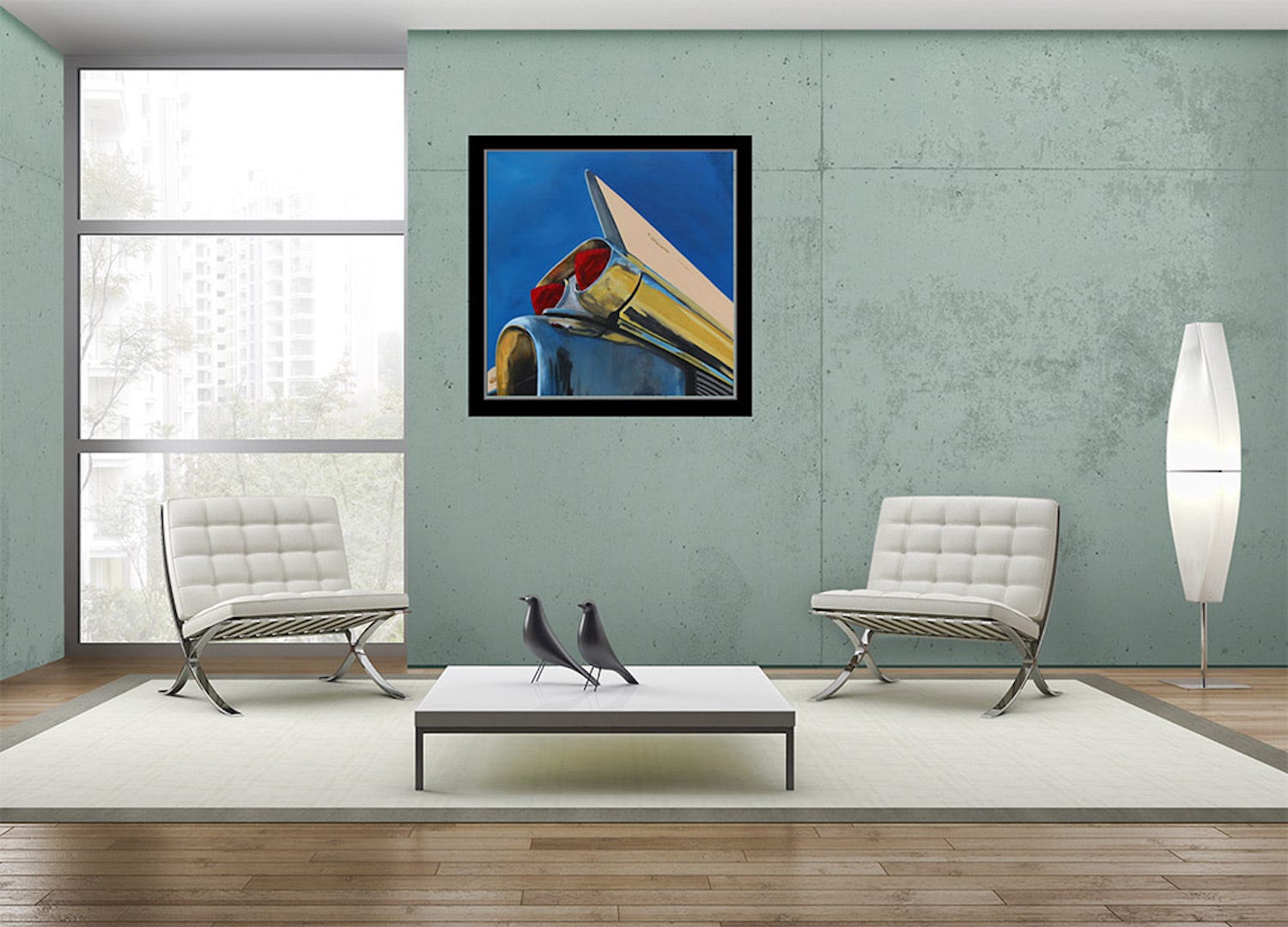
This piece reflects on Cadillac Ranch—ten Cadillacs buried nose-first along Route 66—as a meditation on time, memory, and transformation. Once pristine symbols of the American Dream, the cars now wear decades of graffiti, love notes, and rebellion, layered by countless hands passing through the desert.
The work asks a quiet question—what do cars hear, what do they remember?—and answers it through metaphor: like us, they collect marks, endure erosion, and are reshaped by experience. This painting isn’t just about a landmark or a vehicle; it’s a monument to time itself—how beauty emerges through wear, how meaning accrues in layers, and how something real remains beneath it all.
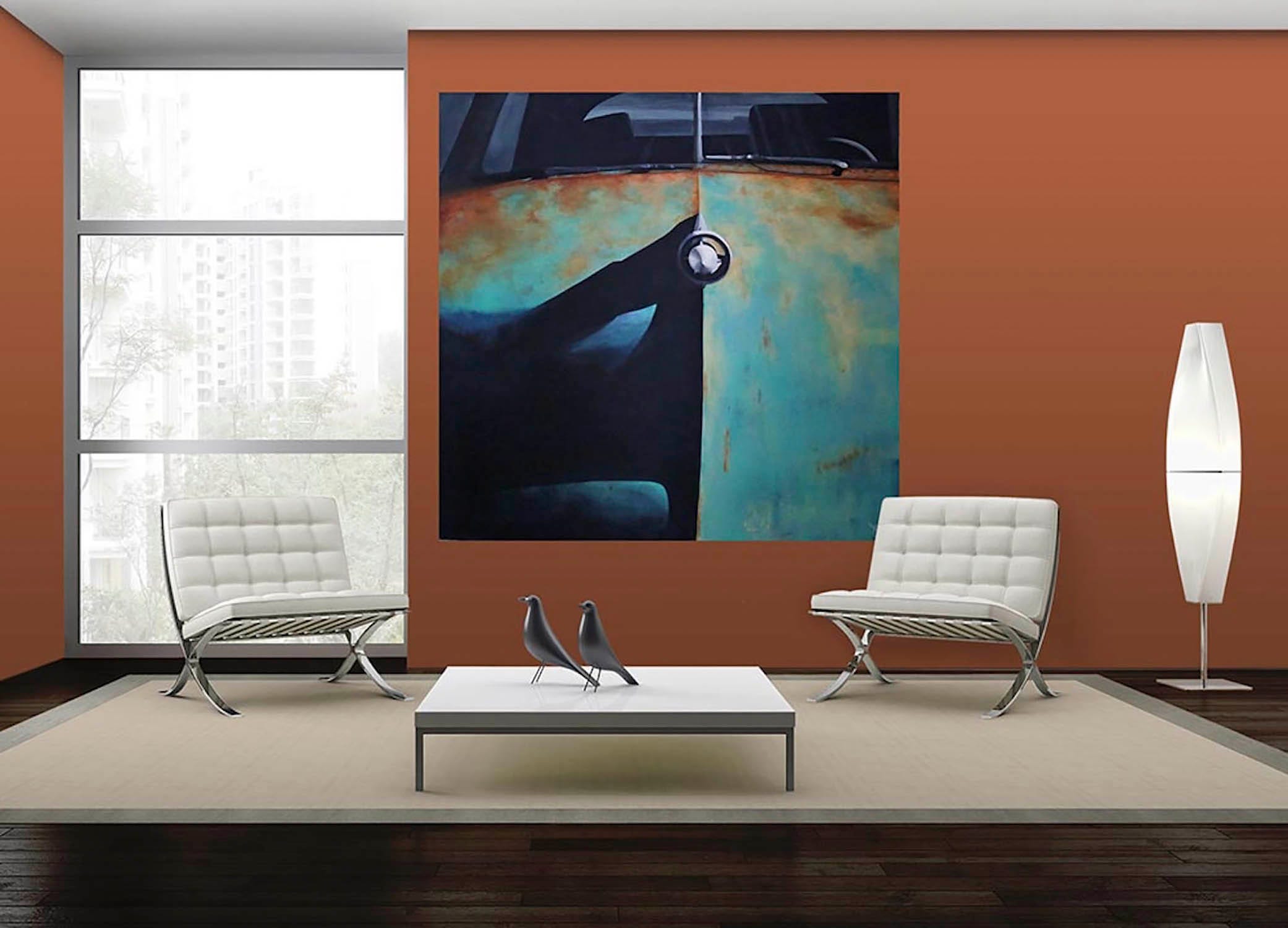
The next, Hollywood Relic, frames cars as vessels of memory—carriers of the roads they’ve traveled, the hands that touched them, and the stories they’ve absorbed. Each painting in the collection acts as a portal to open highways, golden hours, and unforgettable stops, honoring objects built to last and the nostalgia they awaken.
The story behind this painting begins in September 2016 during the filming of American Pastoral in Pittsburgh, starring Ewan McGregor. Between set changes, a classic motion-picture car was photographed—already layered with a past before the film, a role within it, and then a new life on canvas. Translated into a five-by-five-foot painting, the car becomes cinematic nostalgia made tangible: proof that some stories don’t end on screen—they keep traveling.
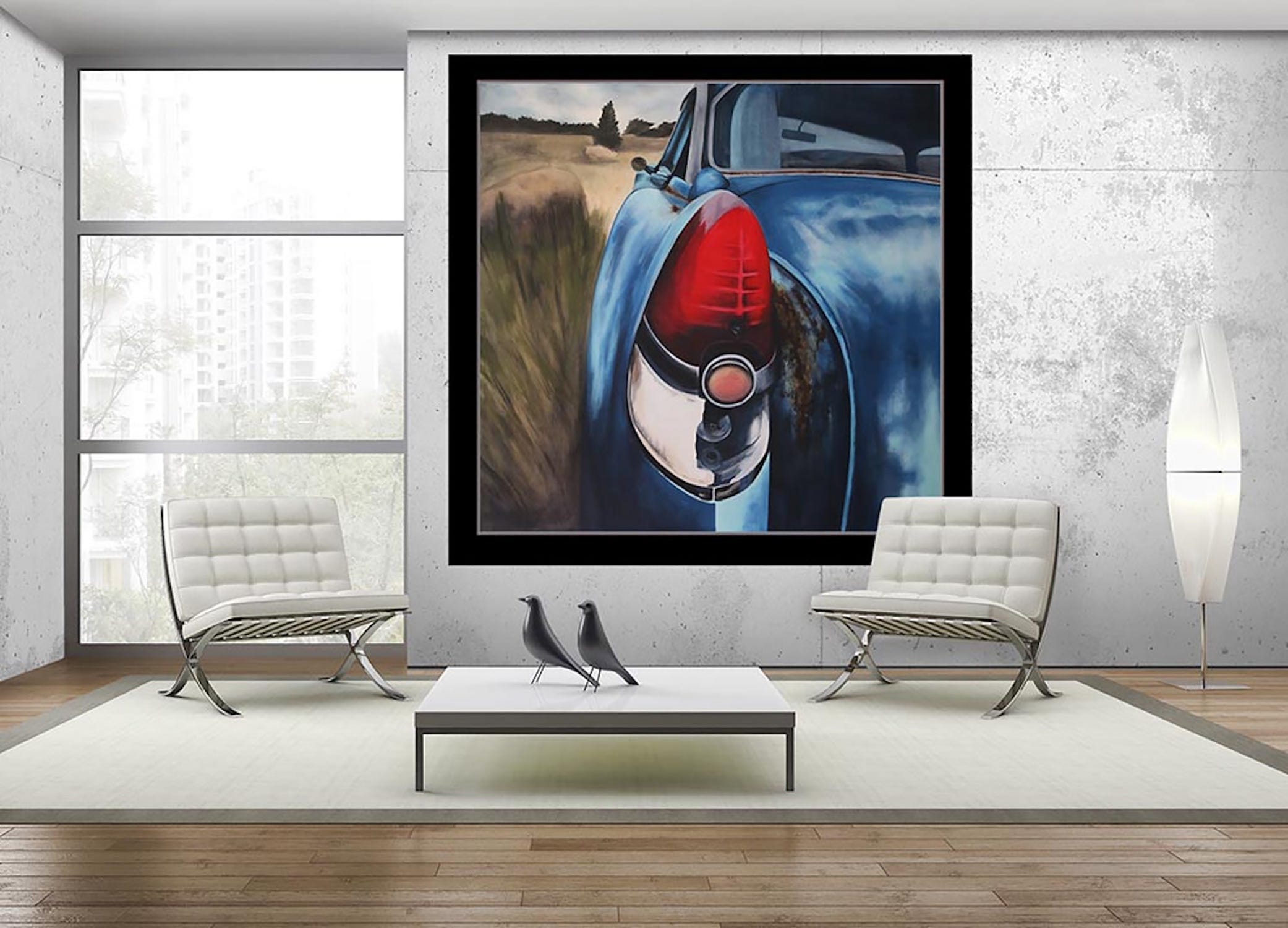
Ghost of the Open Road (above) was spotted on a quiet afternoon along US-34 near Grand Lake, Colorado, this abandoned Cadillac sat like a pause in motion—doors locked, trunk wide open, waiting. We didn’t touch it. We simply witnessed it. Captured in a photograph and later translated onto a large-scale canvas, this painting preserves the quiet dignity, nostalgia, and lingering pull of the open road—proof that even what’s left behind still carries a story.
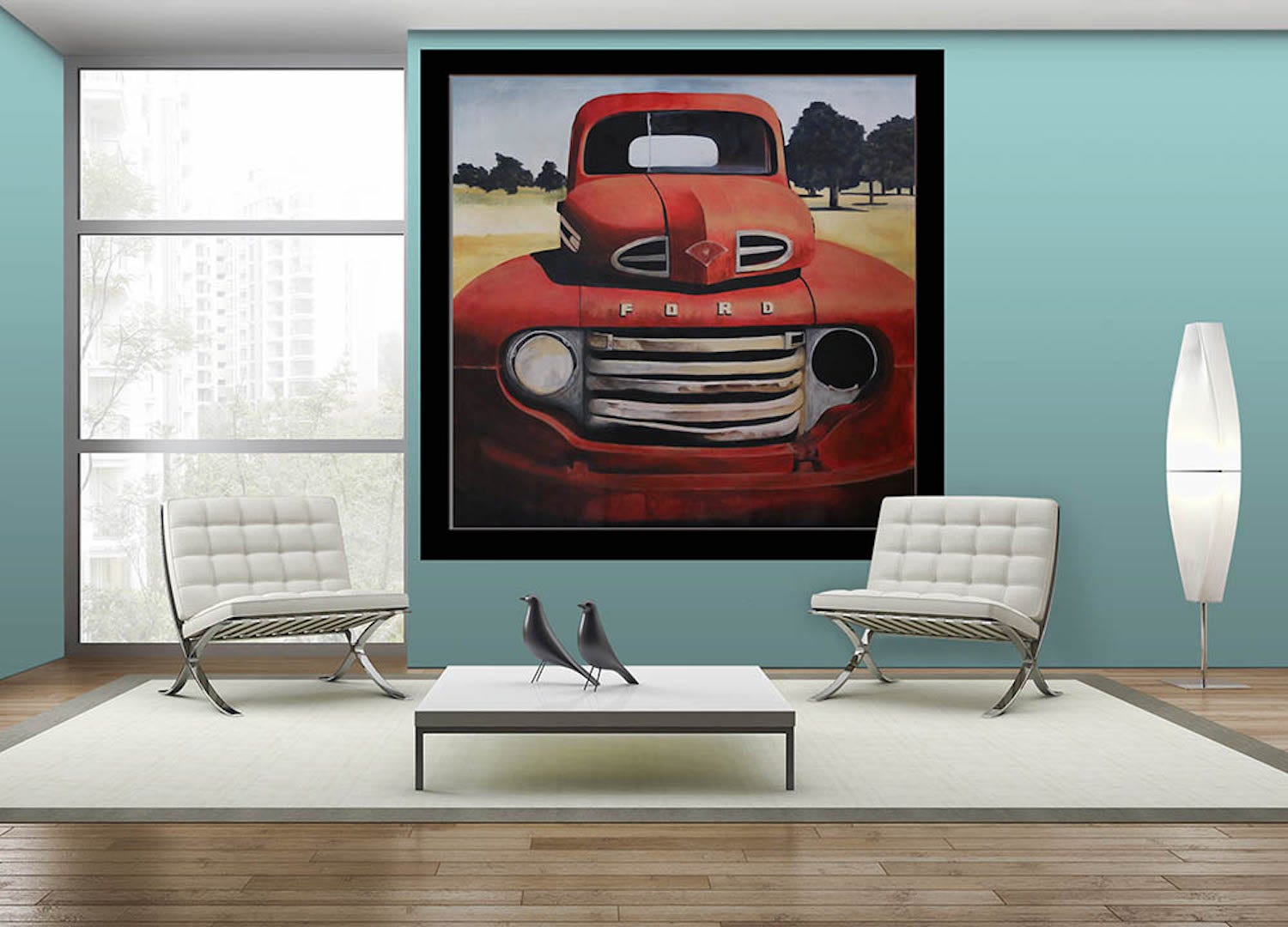
And, last but definitely not least, this Antique Ford (below) continues to be the most popular in the series. The story behind this piece begins with us, The Globe Squatters—two artists drifting across the map—somewhere along Interstate 70, where the sky feels endless and the road never quite ends. We stopped for the night at a KOA, slept in a teepee, wandered into a surreal slice of Americana—and just before it all, there it was: an antique Ford parked outside a boarded-up shop, weathered but dignified, like an old soul waiting patiently.
When I was asked to paint the photograph (below) in the spring of 2025, I said yes without hesitation. What I didn’t realize was that the painting would take on a life of its own—slow, demanding, almost like something forming rather than something being made.
Between back-to-back productions, gallery shows, travel, and everything else life was quietly stacking and life, simply put, unraveled a bit.
This painting waited through all of it. And in many ways, it absorbed it.I started this painting several times. And even when a piece is heading in the wrong direction, I can almost always bring it back to life—but this one refused. For the first time in my life as a painter, it died.
In the end, I had to white it out completely. Erase it. Begin again. It was painful. I had invested so much time and care, only to realize I was lost in the details, unable to see the whole.


Life can feel like that too. Like trying to move forward while the ground keeps shifting beneath you. You return with the same intention—careful, hopeful, convinced that one more adjustment, one more refinement, will make everything resolve. But sometimes you’re simply too close. Too tired. Too deep inside it to see clearly.
This moment isn’t a failure. It isn’t a loss. It’s a reset.
Like the cars along the open road—layered, weathered, paused mid-journey—there are times when the most honest thing we can do is stop, clear the surface, and allow the next image to reveal itself when it’s ready.
Not everything needs fixing.
Some things need space.
I don’t love that answer—relent—because I like getting my hands into things, literally and figuratively. I like fixing, shaping, pushing. But sometimes the work asks for something else.
Recently, an essay by Carla King lingered with me—Let Art Disturb You. Not as a directive, but as a quiet permission slip. A reminder that the work that matters most is often the work that resists comfort and refuses to behave.
What stayed with me was the idea that art isn’t decoration—it’s exposure. That disturbance isn’t a flaw to correct, but a signal to listen more closely. I recognize that truth from my own life: travel, movement, choosing uncertainty again and again, trusting that real transformation only happens when you stay open long enough to be changed.
It was a reminder I needed—
transformation rarely arrives quietly, and the work that wakes us up is worth staying with.
Until next time…
Always a fun, pleasant read. Enjoy your perspective. And love your paintings!
I don’t think I’ve thanked you enough for letting me in side your journey through life, good and bad. You make my day better with your words of wisdom and love. Thank you all the time and always having a positive outlook no matter what the circumstances or what be followers you.