
“Cry, Heart, but never break.”
That line, from the children’s book by Glenn Ringtved, recently came up in my Facebook memories. I had posted it eight years ago.
My response to it today was:
That is like asking the sky to show us the sun, but not the shadows.
I am standing inside an elementary school about half an hour from my house. I am surrounded by two little girls and their mothers, and together we are creating a mural.
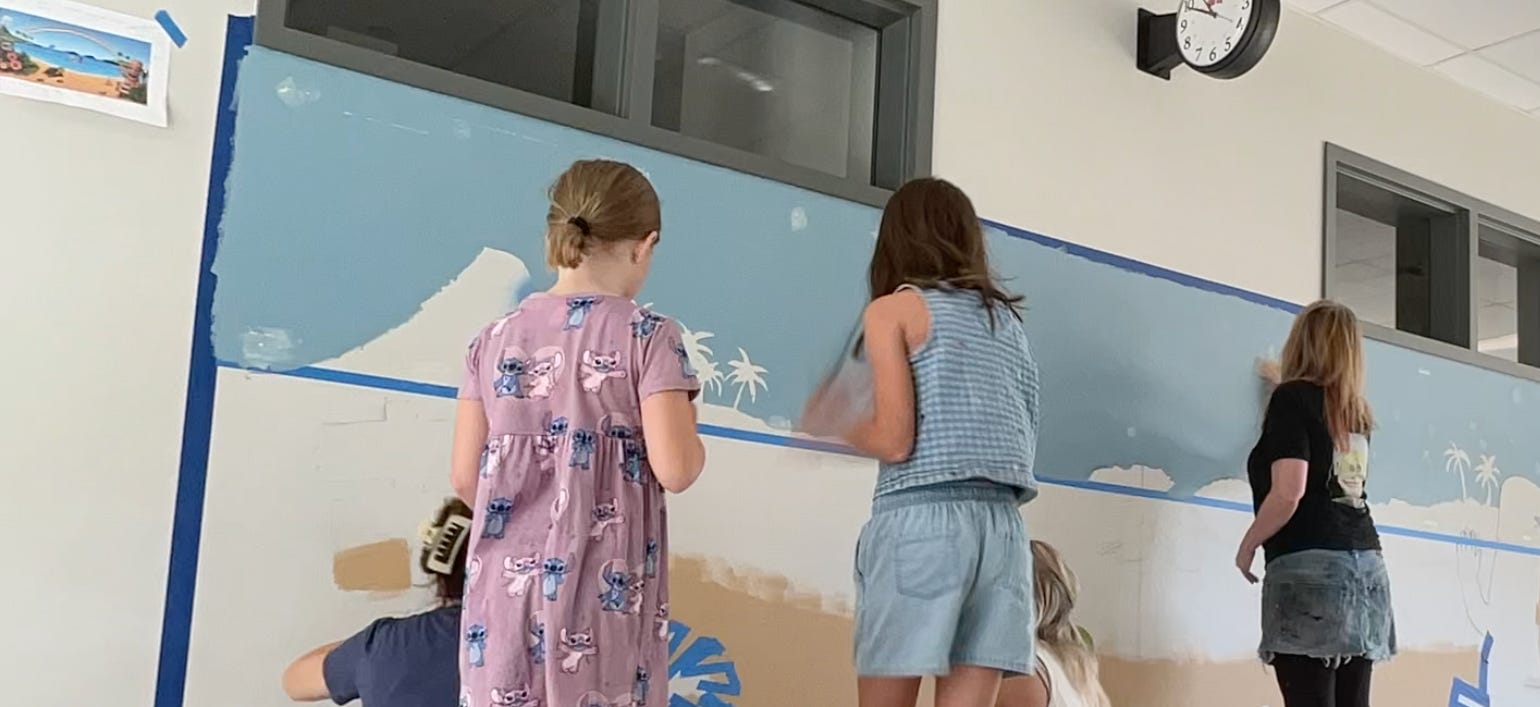
I am showing the girls how to paint with a toothbrush—how to load it with paint and pull a finger across the bristles so that tiny flecks scatter across the wall. It is a great way to make sand.
They are watching me closely, paying attention to every word. Their excitement over using a toothbrush for something other than teeth is palpable. They practice on a piece of cardboard before I cut them loose on the actual wall.
You would have thought I had handed them magic wands.
Standing there, I feel the full resonance of what art can do in our most devastating moments.
It can create a doorway where there was none.
It can become words for things that were never spoken.
It cannot keep a heart from breaking. But sometimes, slowly and imperfectly, it can help stitch together what remains.
The Two Sisters
I met two extraordinary little girls during COVID. They were sisters, two and a half and five years old.
The older sister, Avery, loved science and art. Their grandmother, who is a good friend of mine, told me that the younger sister, Rilyn, was undergoing cancer treatment.
She was only two and a half.
I could feel that her older sister needed an outlet too. She was trying to remain a little girl while her family’s life revolved around hospitals, treatments, and uncertainty.
Around that time, their grandmother told me they had tried to raise a monarch butterfly, but the caterpillar had died.
I immediately reached out to my Facebook community and asked whether anyone had monarch caterpillars growing in their gardens.
Many messages and several hours later, I located thirteen of them more than an hour away.
I met the girls’ grandfather in the parking lot of an Olive Garden to make the exchange, which is the kind of wonderfully strange thing people did during COVID to create moments of connection.
For the next several weeks, Avery and I raised our separate groups of monarchs together.
Everything was virtual. Through video after video, we both learned about the magic of the monarch. Admittedly, I think I was more excited than any of them.
Other families began following the adventure through the photographs and videos I posted on Instagram. I had never raised monarch butterflies before, and I became completely fascinated by them—their transformation, their fragility, and their almost impossible migration. And by the fact that I could successfully raise something other than mold in my paint buckets.
The monarch's journey happens across generations. Several generations move north, each continuing a journey it will never complete. Then one remarkable, long-lived generation travels all the way back south to Mexico.
None of them is given the entire map. Each one simply carries the journey as far as it can.
Navigation began appearing everywhere in my work and thinking: how we know where to go, what guides us, and what happens when the map we were following suddenly disappears. During that same period, I was even commissioned to create a painting that would be auctioned to support monarch conservation.
Avery and I also began doing art classes together online. She called me “her artist.” I have to tell you, it was the best feeling when I started Zoom one day, and there was little Avery dressed in an artist’s outfit, complete with a tiny beret.
She was ready to paint.
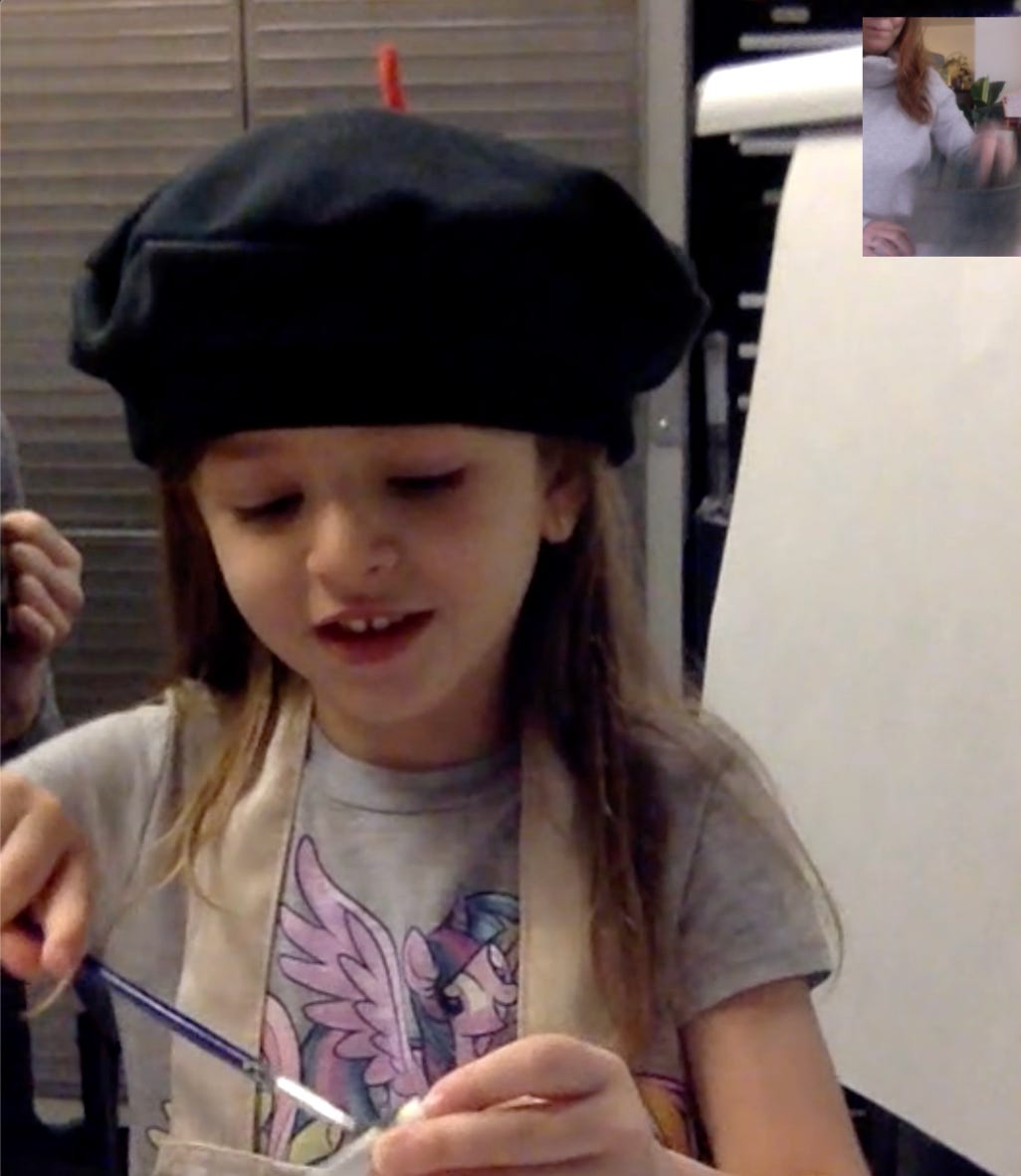
When Rilyn eventually became stable enough, they both came to my house and painted with me in person.
It was a beautiful day.
Rilyn had spent so much of her life going in and out of Children’s Hospital. Her sister had spent those same years trying to have something resembling a normal childhood. That afternoon, in my little Casa Petita garage, they were simply two sisters making art.


Rilyn’s Corner
Now I am standing inside their elementary school, painting Rilyn’s Corner.
Rilyn died on November 29, 2025, after courageously fighting neuroblastoma for five and a half years. But she was not only a little girl with cancer. She was a joyful, loving light and full of hope. Her love for Lilo & Stitch, Taylor Swift, stuffed animals, and fluffy dogs was unmatched.
Her grandmother, my dear friend, called me in March to ask whether I would design and paint a mural in her memory. She told me the family had been given a small amount of money to help cover the supplies.
Now Rilyn’s sister, Rilyn’s best friend, their mothers, and I are standing together in front of this enormous wall.
We are painting sea turtles on a sandy beach.
From the beginning, I designed the mural so that anyone who loved Rilyn and wanted to help could place their own hand inside its creation.
They will remember this for the rest of their lives. They will know that they helped make something beautiful for a little girl who touched so many lives during her very short life.
I cannot begin to imagine what it takes for these girls to stand here and paint after something so traumatic. But I also know from my own experience that resilience is a muscle—one built slowly through love, support, and the courage to keep showing up.
I cannot help but wonder who these children will become because of the strength, tenderness, and connection being formed around Rilyn now.
Children are often asked to carry enormous things while adults search for the right words. Art does not demand that we find them. It gives our hands somewhere to place what we are carrying.
In that moment, surrounded by sea turtles and beaches, I watched Rilyn’s best friend—dressed in a Lilo & Stitch outfit—come alive as she flicked paint from a toothbrush. Beside her, Avery gently showed her how to hold it, how to aim the paint, and encouraged her to keep going.
Watching them, I could see the big sister Avery had been to Rilyn being carried forward into this moment.
Designing an Escape
Rilyn loved Hawaii. She loved Lilo & Stitch, a story about family, belonging, and the promise that no one should be left behind or forgotten.
Hawaii also has a deep personal meaning for me.
When her family told me I could design the mural however I wanted, the connection felt immediate. Her mom sent me one of her favorite photographs of the two girls on the beach for inspiration.
I completed what I thought was the final design last Thursday. But something did not feel right.
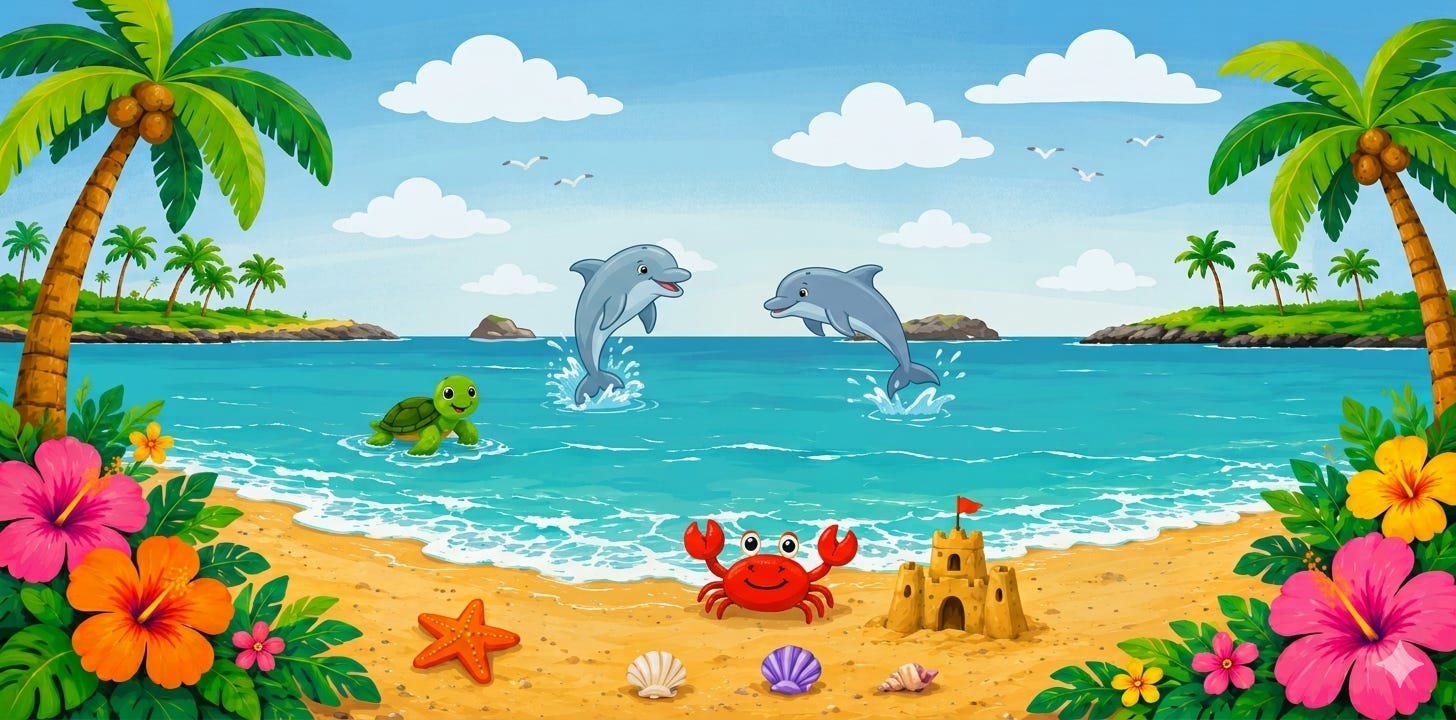
I kept returning to it—shifting the landscape, simplifying some elements, moving others, and trying to understand what the wall itself was asking for.
The first version was cute, but it felt impersonal. It needed more than decoration. It needed symbolism. I wanted every element to feel like part of the same story, each one carrying some piece of the larger idea that nothing exists alone.
The finished design contains a beach, calm blue water, distant land, palm trees, sea turtles, dolphins, a rainbow, a friendly tiki figure, and two children sitting side by side on paddle boards, facing away from us and looking toward the horizon.
Each piece carries something.
The water creates movement without chaos. It gives the eye somewhere to travel.
The horizon suggests that something still exists beyond the moment we are standing in, even when we cannot reach it yet.
The turtles carry endurance, protection, and the ability to find their way home across enormous distances.
The rainbow is both weather and promise: light and water meeting after a storm. A bridge between this life and whatever may come after it.
The two children on the paddle boards are together, but they are not being asked to speak. They are allowed simply to sit beside each other and look outward.
The dolphin in the water before them is a gentle, playful guide toward healing.
The cardinal as a symbol for all of those who continue to speak to use from the other side.
The butterfly connects the mural to those early COVID days, to transformation, and to a journey continued across generations. Rilyn’s mom also told me that she had always referred to Rilyn as her butterfly.
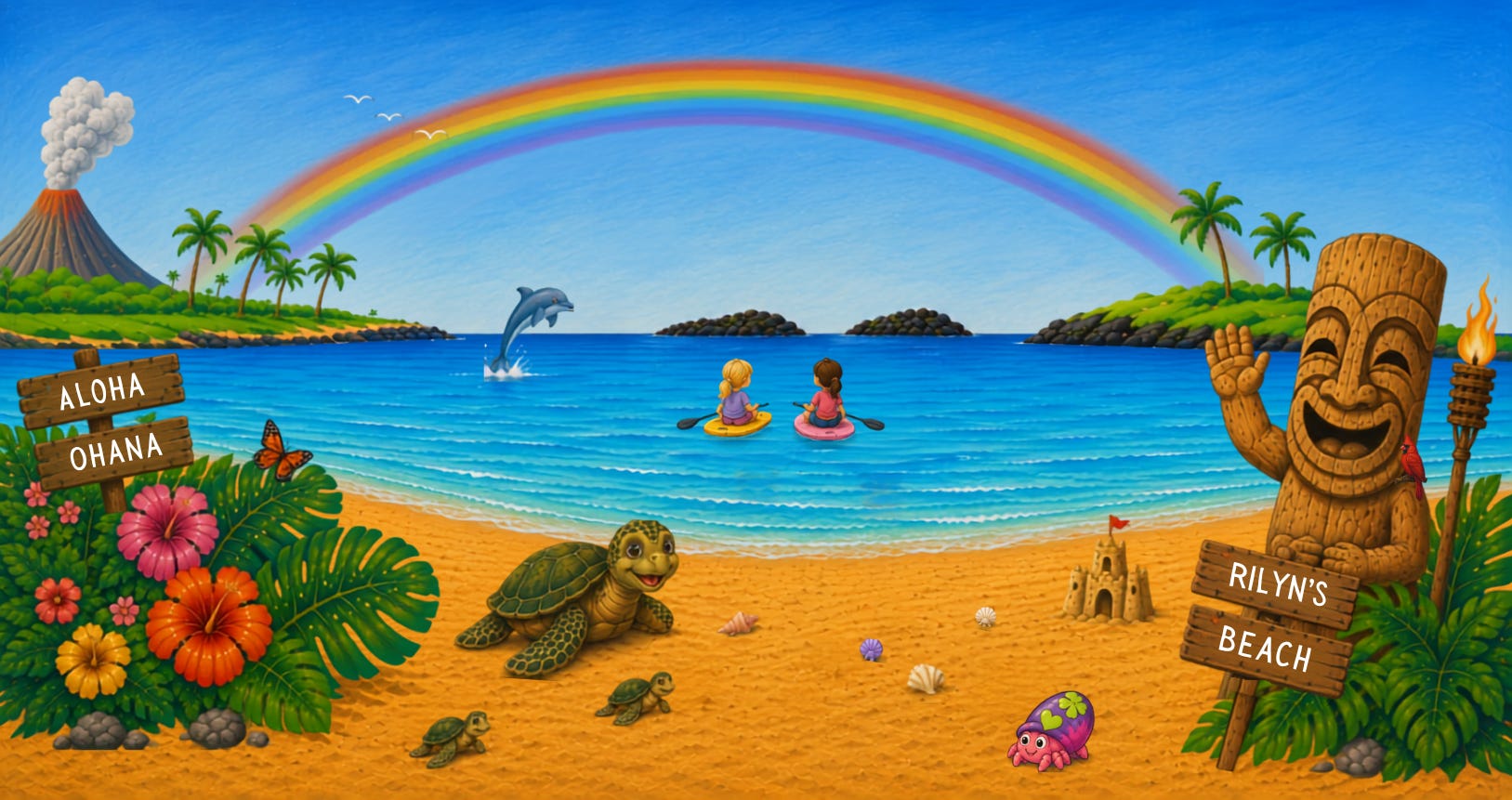
This could not feel like a memorial children were afraid to touch. It needed to feel alive. I wanted to create a place where children could feel transported for a few moments. A decompression space made from paint.
Here is a glimpse of that little world beginning to take shape.
The mural is near the cafeteria, in the middle of all the noise and movement of an elementary school. Just down the hall, there will now be a small hidden world where a child can pause and feel held by the space—not singled out, not watched, and not required to explain why they need it.
My background in scenic art, color theory, visual storytelling, and feng shui all came into the design. I wanted the colors to feel calm without being dull. I wanted the landscape to move the eye gently through the wall. I wanted the space to feel protective without feeling closed in.
I wanted children to feel that they belonged there. A children’s mural must hold joy first. But sometimes joy is a secret gateway into healing grief.
Continue Reading
Below, I am sharing the more personal layer beneath this mural: why creating a place for grief feels so connected to my own loss, what this project has taught me about the ways people measure pain, and why I believe making something beautiful can help us live beside what cannot be fixed.