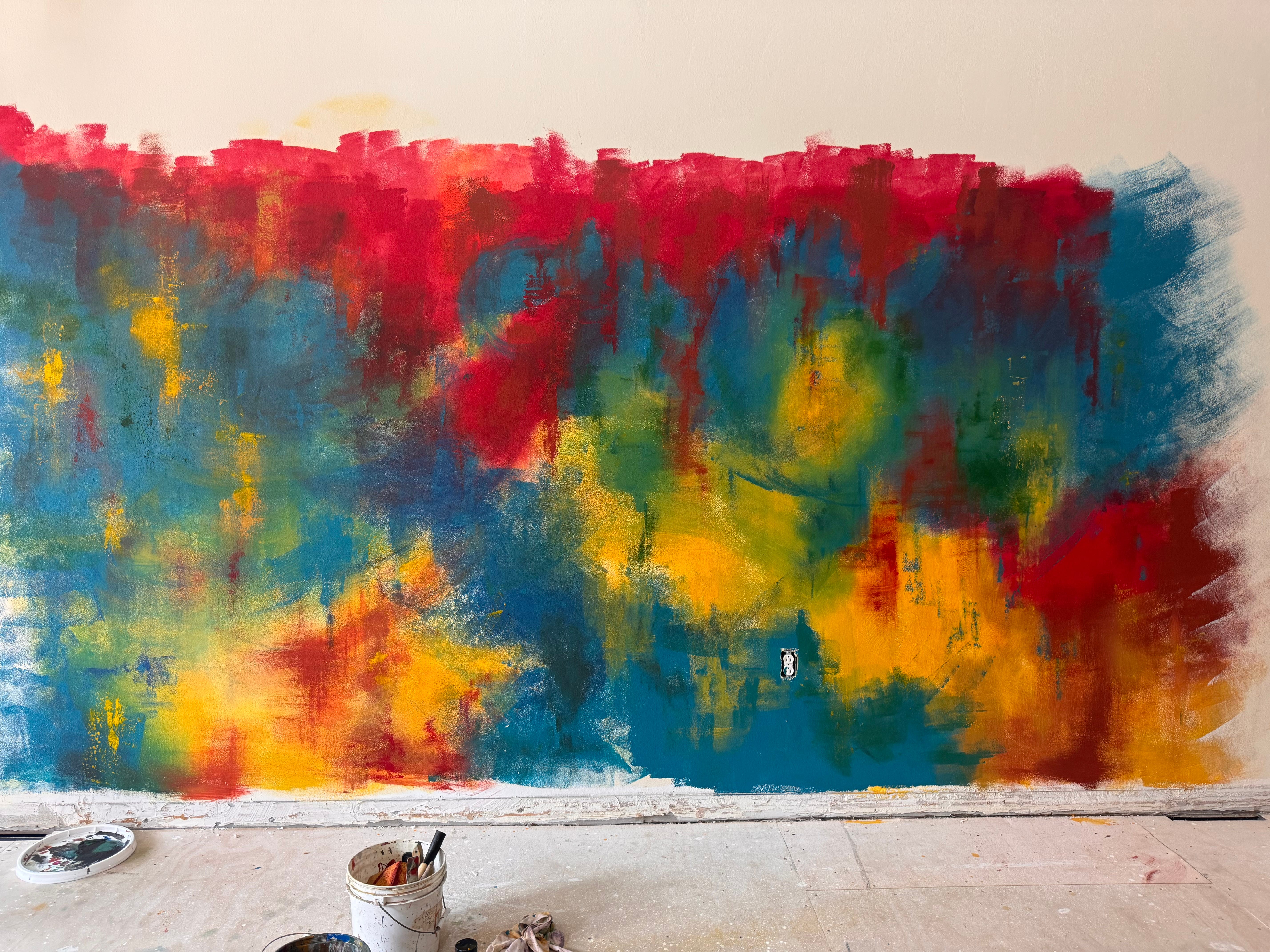
Over the summer, I was commissioned to paint a mural for Los Sabrosos in Garfield, Pittsburgh—a space rooted in movement, rhythm, and community. It’s a dance studio, yes, but it’s also a place where bodies remember joy, where music becomes language, and where people come to reconnect with themselves through motion.
From the outside, the project looked simple enough. I bid the job assuming it would take two days. I’ve painted far more complex surfaces under far tighter deadlines. This felt manageable. Familiar, even.
It wasn’t.
The mural was abstract—something I don’t typically do at this scale or in this way. My usual approach is structured: a photograph, a rendering, a clear translation from small to large. Precision. Control. Planning. That’s how I’ve survived decades in the film and television industry—by knowing how to reverse-engineer an image and execute it efficiently under pressure. I was made for that.
But this mural didn’t want that version of me.
Instead, I found myself creating a series of loose, exploratory paintings—marks that felt more like gestures than plans. The process demanded something uncomfortable: organic decision-making in real time. No rigid roadmap. No predetermined outcome. Just listening, responding, adjusting.
That alone was a departure from my normal way.
When I finally began painting, time collapsed. What was meant to be an 8×10 foot mural grew closer to 10×12, not because I didn’t measure correctly, but because the work insisted on more space. I didn’t stop. I didn’t take breaks. I went so deep into it that I worked nearly fourteen hours straight, completely absorbed.
It wasn’t effort.
It was immersion.
The wall stopped feeling like a surface and started behaving like a collaborator. I wasn’t fixing or correcting—I was following. The Los Sabrosos team gave me room to do that. They trusted the process, asked thoughtful questions, and never rushed the work. That kind of ease is rare, and it matters.
What the Mural Set in Motion
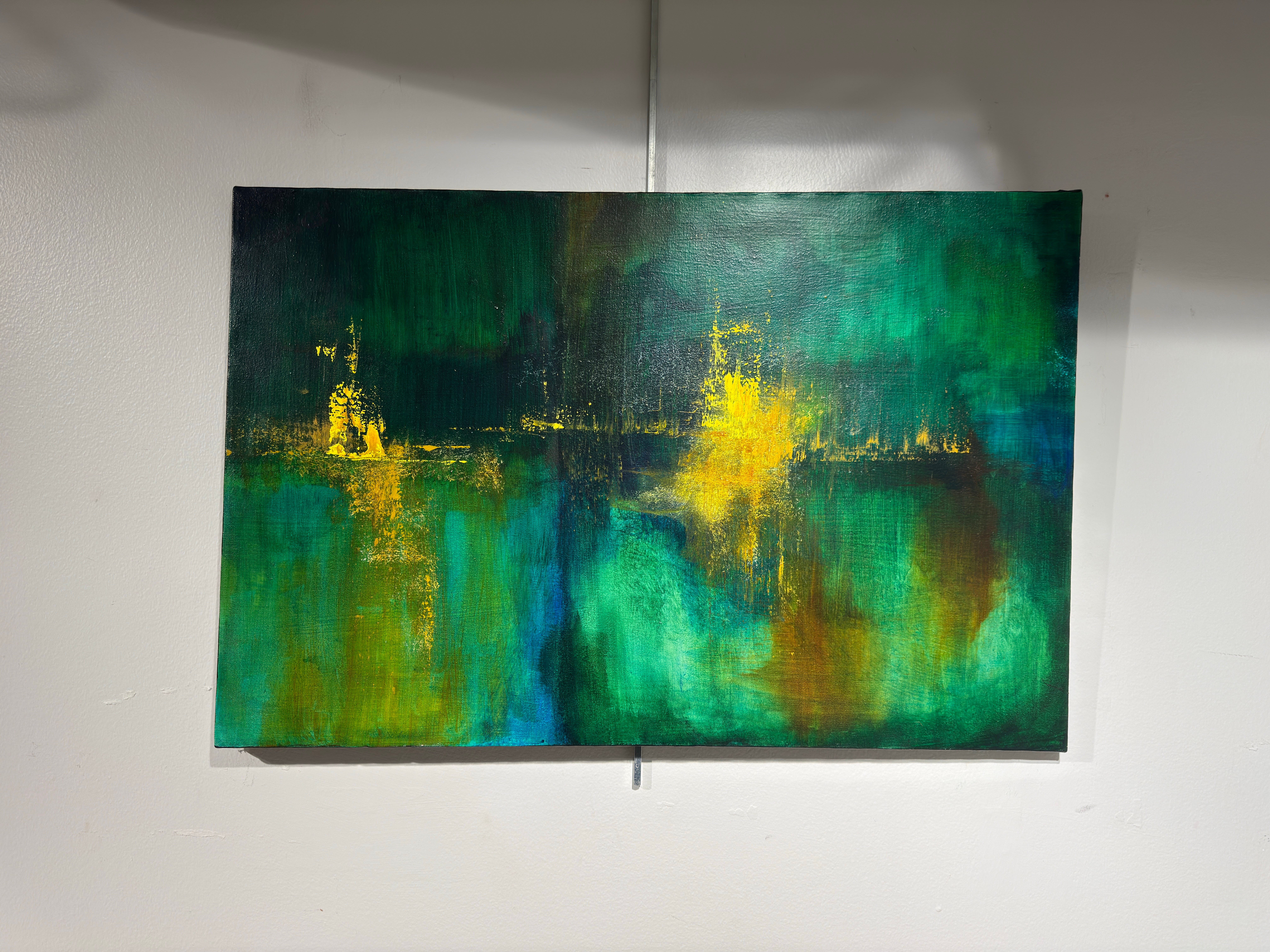
While painting the mural, I finally understood the importance of allowing the intuitive artistic process to take over. There was no planning these mark,s they were just loose concepts waiting to merge with my paintbrush.
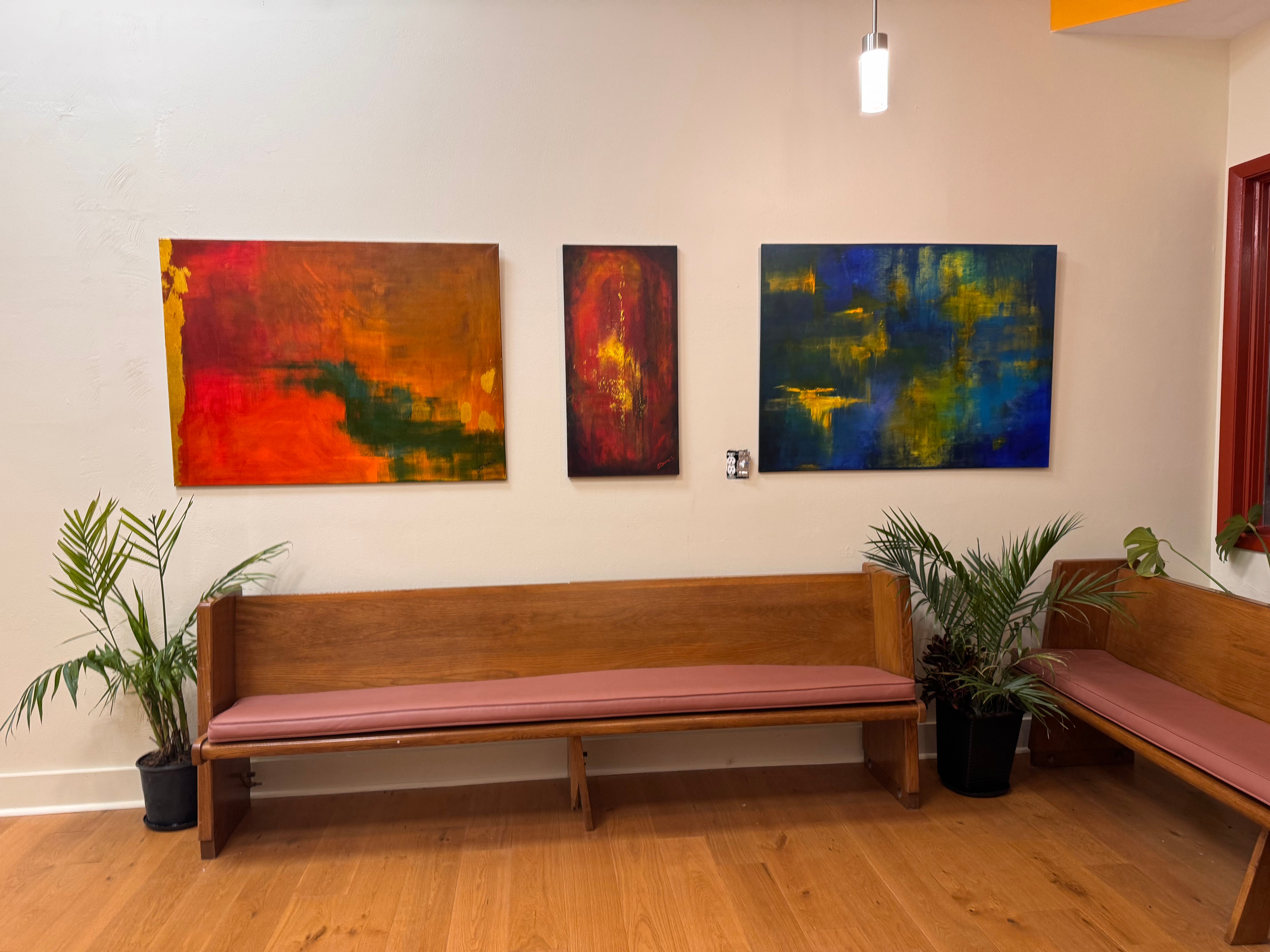
After I finished that mural I was so inspired with the idea of creating abstracts that I painted an entire series for the grand opening. These weren’t planned pieces. They emerged as echoes of the mural itself, like afterimages. I didn’t overthink them. I let them happen.
The night of the opening I asked if I could do a live painting event. There I would complete four abstracts in roughly four hours while accompanied by a live cello player. As an On Set Scenic Artist for movies and television I am very used to painting in front of a crew of many people. But honestly, painting in front of anyone changes the stakes. There’s no hiding. No reworking in private. You move forward or you don’t move at all.
That body of work became my abstract series. And that series arrived at a moment when my personal life was quietly unraveling.
When it came time to hang the show in October, my father was killed in a car crash.
There’s no clean transition into that sentence. There wasn’t one in life, either.
Naming What Remained
Before my father’s death, I had posted the abstract works online and asked people to help name them. The response was overwhelming. One post alone received over forty thoughtful suggestions—poetic, intuitive, generous offerings from people who felt something in the work and wanted to give it language.
At the time, I chose titles and moved on.
After he died, I went back.
I reread every comment. Slowly. Carefully. And instead of choosing the names I liked best, I chose the names he had suggested. That’s how the series was ultimately named.
What began as an abstract mural commission became something else entirely:
a shift in my process, a release of control, and an unintentional tribute.
What I Know Now
I’ve spent much of my life fixing things—surfaces, spaces, images, problems. I like shaping, refining, pushing forward. That instinct has served me well. But this body of work reminded me of something I don’t always want to admit.
The mural didn’t need to be controlled.
The abstracts didn’t need to be planned.
And grief didn’t need to be resolved.
None of it was asking for answers or efficiency or closure. It wasn’t a problem to solve. It was a moment to stand inside, without rushing toward meaning. The only real requirement was attention—to stay present long enough for the truth of it to surface on its own.
It needed to be witnessed.
This series stands as a record of that moment—a threshold between ways of working, ways of being, ways of understanding what art is allowed to do.
Tribute
With the abstracts finished, named and hung I did a little write up and posted it at the entrance of the room.
I’m Jolene Dames—artist, alchemist, and storyteller—and I believe every space tells a story. After decades working in film and television, I create art and experiences that transform walls and rooms into reflections of the people who live among them.
This series of abstracts is named in honor of my father, Ron Drylie (1951–2025)—a man of music, mystery, and gravity.
Almost every time I approach a surface—really, every time—I have a rendering first. A smaller-scale painting or drawing. A conceptual guide. An artist’s roadmap. That’s how I was trained in theater, and it’s how I understand scale, surface, and execution. It’s what gives me confidence when I’m standing in front of a 60’x48’ backdrop for the Oklahoma Philharmonic, brush in hand, knowing exactly where I’m going—even when the scale itself is intimidating. Which, to be honest, is!
That kind of intimidation is familiar. It’s logistical. It’s solvable.
These abstracts were different.